Is Endolift safe?
Endolift is a very safe treatment in the right hands. It has been performed many thousands of times across Europe and around the world, and the great majority of patients have a straightforward experience with a short recovery.
When it does go wrong, the cause is rarely the treatment itself. In my experience, and in the pattern of cases that circulate within the profession, serious complications come overwhelmingly from three things: counterfeit devices, procedures performed by people who are not doctors, and practitioners who have not been properly trained in facial anatomy. Almost everything in this article comes back to those three factors, because avoiding them is most of what safety means in practice.
What is Endolift, and why does technique matter?
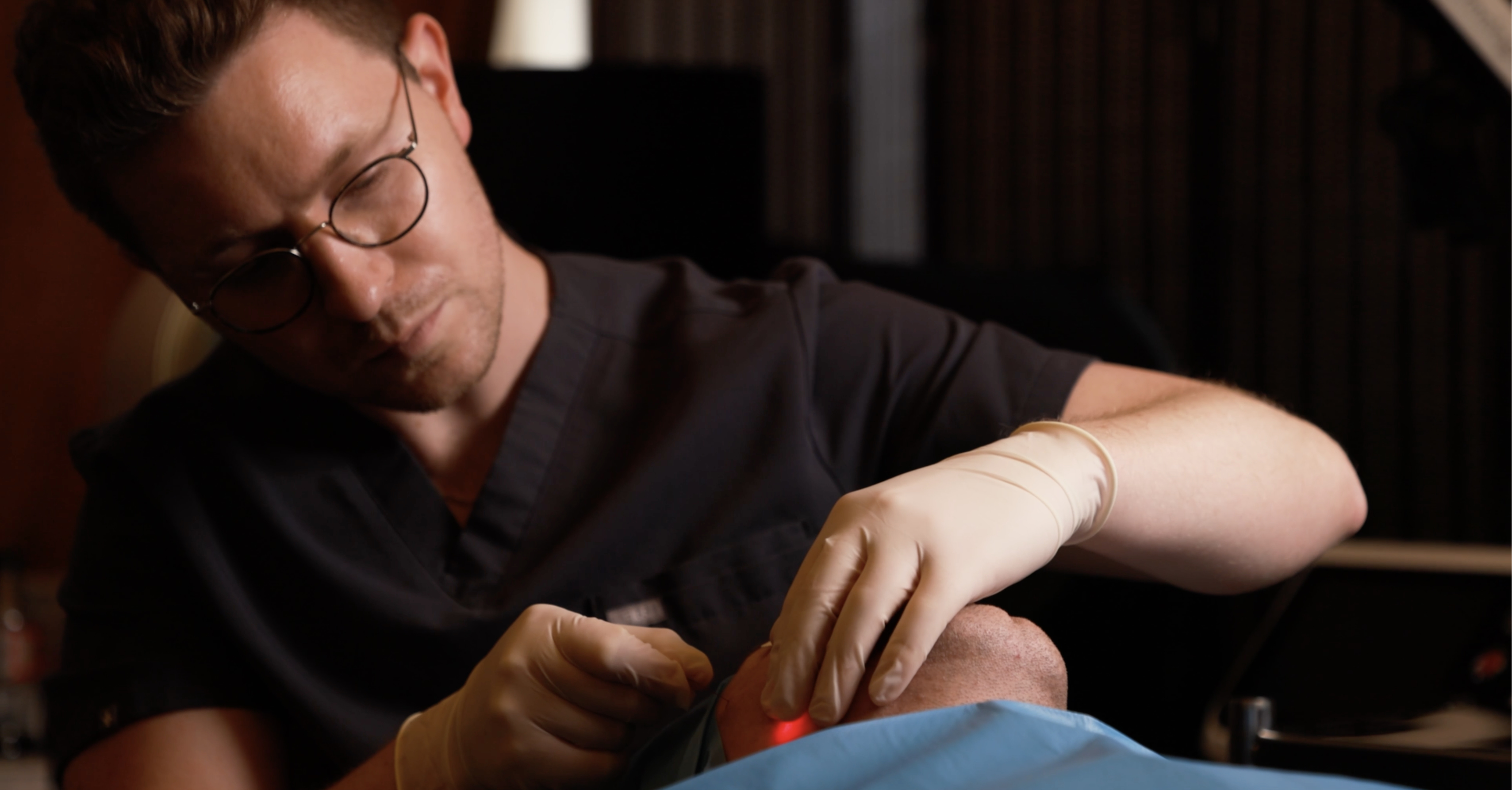
Endolift is a minimally invasive laser treatment for skin laxity and small pockets of fat. Very fine fibres are placed just beneath the skin and deliver laser energy directly into the deeper layers, heating the tissue in a controlled way to stimulate collagen and tighten over the following months.
"Minimally invasive" is true, but it can be misleading. The fibre is emitting laser energy into a plane that contains nerves, blood vessels and glands. That is precisely why the procedure can carry significant risk when it is performed by someone who is not a doctor, who is not using a genuine device, or who has not been trained properly in the anatomy of the face. The treatment is gentle. The margin for error is not, and that is entirely down to who is holding the fibre.
What does everyone experience after Endolift?
It helps to separate the normal after-effects, which nearly everyone has, from genuine complications, which are uncommon. Because a fibre has passed beneath the skin, most people can expect:
Bruising, typically lasting anywhere from three to fourteen days. This is very common and more or less unavoidable.
Mild swelling for roughly one to three days, which then subsides.
A tingling sensation that can last around six weeks before wearing off on its own. This is not a complication. It is the superficial nerve responding to the heat of the laser, and it settles by itself.
None of these are causes for concern. They are the ordinary signs of the tissue healing.
What are the serious complications, and how are they prevented?
These are uncommon, and the reason for setting them out plainly is to show what good practice is actively protecting against.
Infection and abscess
Any procedure that passes through the skin can introduce infection. An abscess becomes far more likely if sterile technique is not maintained: no sterile gloves, no sterile field, no proper aseptic approach. It can also occur if the wrong layer is punctured, for example passing into the mouth, or if too much energy is used, melting too much fat without appropriate aftercare to help the body clear it.
This is largely preventable. Whoever performs your treatment should have a solid understanding of how to maintain a sterile field. It is worth adding that routine prophylactic antibiotics are not, in my view, necessary to prevent this, and I do not give them routinely. Good technique is the safeguard, not a course of antibiotics after the fact.
Nerve injury (neuropraxia)
This is the complication careful practitioners think about most, and it is where anatomy matters more than anything else. A neuropraxia is a temporary malfunction of a nerve. In the lower face, the marginal mandibular nerve is the one most at risk. It controls movement at the corners of the mouth.
If someone treats the wrong area, lacks a proper knowledge of anatomy, or does not have the technical control to keep the fibre at the correct depth, this nerve can be injured. The result can be a facial palsy lasting three to four months, which can resemble a mild stroke or Bell's palsy, and can affect feeding, speech and appearance while it recovers.
Written plainly, that sounds frightening. The reassurance is this: in a properly trained practitioner, the normal course of these nerve branches is known, the safe depth is understood, and the fibre is kept where it should be. The injury happens when that knowledge or that control is missing. It is, in other words, an avoidable complication rather than an inherent one.
Other risks
As with any laser procedure, there is also a smaller risk of burns or thermal injury to the skin, contour irregularity, or changes in pigmentation. These too are minimised by correct energy settings, correct depth and appropriate aftercare.
An honest word: complications are part of medicine, and any practitioner who claims their treatments carry no risk at all is not being straight with you. The mark of a good doctor is not pretending complications never happen, but knowing how to prevent them and how to manage them if they do. What the evidence and experience show clearly is that the risk falls dramatically when three conditions are met, which brings us to the practical part.
Why the practitioner matters far more than the device
Patients often research the machine. That is reasonable, but it is the smaller part of the equation. A genuine Endolift device in skilled hands is safe. The same device in untrained hands is not made safe by being genuine.
This is the part of my own background that is directly relevant. I am dual qualified in medicine and dentistry, I have worked in maxillofacial surgery for over 5 years, and I spent time teaching facial anatomy to undergraduate and graduate medical students at the University of Cambridge. That means a detailed, working knowledge of the anatomy of this exact region, which most practitioners, and in truth most doctors, simply do not have. My background in surgery and dentistry also trained the fine motor control the procedure depends on, keeping the fibre at precisely the right depth, which is where the difference between a good result and a nerve injury actually lives. I am also a trainer for the device and hold an award from Endolift for outstanding achievement in the technique.
I set that out not as a sales pitch but because it is the whole point of the article: the safety of Endolift is, in the end, the knowledge and control of the person performing it.
"A genuine device in skilled hands is safe. The same device in untrained hands is not made safe by being genuine."
— Dr Rob Humphries, Clinical Director
Questions to ask, and warning signs to heed
You are entitled to ask all of these, and a good practitioner will welcome them:
- Are you a doctor? Always check. Never assume.
- Are you registered to perform Endolift? You can look this up. The official Endolift website lists registered practitioners, which also helps confirm the device is genuine rather than a counterfeit.
- Is the device an official Endolift system?
- What is your training in facial anatomy specifically, not just in operating the device?
- Who will actually perform the procedure, and what are the aftercare arrangements?
And one clear piece of advice: do not be seduced by a cheap price. A treatment priced well below the rest of the market is a signal, not a bargain. The cost of correcting a complication, in money, time and distress, dwarfs whatever you saved, and some of these injuries are not things you want to experience at all. This is not a treatment to shop for on price.
The honest conclusion
Endolift is a safe and effective treatment for the right patient in the right hands. The serious risks are real but avoidable, and they concentrate exactly where you would expect: counterfeit devices, non-medical operators, and a lack of anatomical training. Choose a doctor who is qualified in the procedure, uses an official device, and has genuine facial anatomy training, and you have removed most of the risk before you ever sit in the chair.
Frequently asked questions
Is Endolift safe?
Yes, in the right hands it is a very safe treatment, performed many thousands of times worldwide. Safety depends heavily on the practitioner being a trained doctor, using a genuine device, with real knowledge of facial anatomy.
What are the side effects of Endolift?
Most people have some bruising for three to fourteen days, mild swelling for one to three days, and a tingling sensation for around six weeks. These are normal after-effects rather than complications and settle on their own.
What is the most serious risk of Endolift?
The main serious risk is temporary injury to a facial nerve, particularly the marginal mandibular nerve, which can cause a facial palsy lasting three to four months. It is largely avoidable with proper anatomical knowledge and technique.
Why do some people have bad Endolift results?
Serious problems come mainly from counterfeit devices, treatment by people who are not doctors, or practitioners without detailed facial anatomy training, rather than from the procedure itself.
How do I choose a safe Endolift practitioner?
Confirm they are a doctor, check they are listed on the official Endolift register, confirm the device is genuine, and ask about their facial anatomy training. Avoid choosing on price alone.
Book a consultation
The safest Endolift result starts with an honest assessment of whether it is right for you, performed by a doctor who knows the anatomy of the region in detail. Consultations are available at Aion Labs in London.